Class 11 Physics (India): Acceleration vs. time graphs


Description
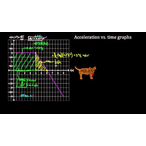
David explains how to read an acceleration vs. time graph. He then shows how the area under the curve gives the change in velocity and does a few examples.
Class 11 Physics (India)
Let's learn, practice, and master topics of class 11 physics (NCERT) starting with kinematics and then moving to dynamics with Newton's laws of motion, work, energy, and power. Let's then use these as the foundation to learn about centre of mass, rotational motion, gravitation, solids, fluids, thermodynamics, and oscillations and waves.
Acceleration
In a world full of unbalanced forces (which you learn more about when you study Newton's laws), you will have acceleration (which is the rate in change of velocity). W…
Frequently asked questions
There are no frequently asked questions yet. If you have any more questions or need help, contact our customer service.
David explains how to read an acceleration vs. time graph. He then shows how the area under the curve gives the change in velocity and does a few examples.
Class 11 Physics (India)
Let's learn, practice, and master topics of class 11 physics (NCERT) starting with kinematics and then moving to dynamics with Newton's laws of motion, work, energy, and power. Let's then use these as the foundation to learn about centre of mass, rotational motion, gravitation, solids, fluids, thermodynamics, and oscillations and waves.
Acceleration
In a world full of unbalanced forces (which you learn more about when you study Newton's laws), you will have acceleration (which is the rate in change of velocity). Whether you're thinking about how fast a Porsche can get to 60mph or how long it takes for a passenger plane to get to the necessary speed for flight, this tutorial will help.
Topic: Science
Learn about all the sciences, from physics, chemistry and biology, to cosmology and astronomy, across hundreds of videos, articles and practice questions.
Share your review
Do you have experience with this video? Submit your review and help other people make the right choice. As a thank you for your effort we will donate $1.- to Stichting Edukans.There are no frequently asked questions yet. If you have any more questions or need help, contact our customer service.