Khan Academy: 2757 products
Khan Academy is an organization on a mission. We're a not-for-profit with the goal of changing education for the better by providing a free world-class education for anyone anywhere.
All of the site's resources are available to anyone. It doesn't matter if you are a student, teacher, home-schooler, principal, adult returning to the classroom after 20 years, or a friendly alien just trying to get …
check_box_outline_blank
Health and medicine: Risk factors for dementia


Visit us (http://www.khanacademy.org/science/healthcare-and-medicine) for health and medicine content or (http://www.khanacademy.org/test-p…
VideoFree6 minutes
check_box_outline_blank
Class 10 Physics (India): Sign conventions for mirror (& lenses)
Let's explore the sign conventions (rules to assign +ve and -ve values) we use for mirrors and lenses. These rules are called Cartesian sig…
VideoFree10
check_box_outline_blank
Class 11 Physics (India): Elastic and non elastic materials
Is steel more elastic than rubber? We all have some intuition for elastic and non-elastic materials. But how do we define elasticity? How d…
VideoFree12
check_box_outline_blank
Class 11 Physics (India) - Hindi: Displacement from time and velocity example (Hindi)
Worked example of calculating displacement from time and velocity. Class 11 Physics (India) - Hindi To help students who prefer to learn by…
VideoFree4
check_box_outline_blank
Class 12 Physics (India): Magnetic force on a proton example (part 2)
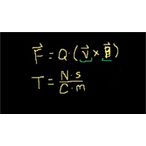
Sal determines the radius of the circle traveled by the proton in the previous example by using the formula for centripetal acceleration. C…
VideoFree11 minutes
check_box_outline_blank
Class 11 Physics (India): Slope of a line secant to a curve
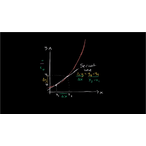
What is the slope of a line between two points on a curve? This is called a "secant" line. Class 11 Physics (India) Let's learn, practice, …
VideoFree7
check_box_outline_blank
Class 11 Physics (India): Stellar distance using parallax

Stellar Distance Using Parallax Class 11 Physics (India) Let's learn, practice, and master topics of class 11 physics (NCERT) starting with…
VideoFree12 minutes
check_box_outline_blank
Physics: AP Physics 1 review of Centripetal Forces

In this video David explains each concept for centripetal motion and solves an example problem for each concept. Physics Learn about the ba…
VideoFree16 minutes
check_box_outline_blank
Class 12 Physics (India): Photon Energy

In this video, David explains what a photon is and how to determine the energy of a photon. Class 12 Physics (India) It is now time to dive…
VideoFree9 minutes
check_box_outline_blank
Physics: Projectile motion (part 2)
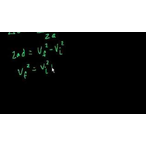
A derivation of a new motion equation Physics Learn about the basic principles that govern the physical world around us. Solid understandin…
VideoFree9 minutes
check_box_outline_blank
Class 11 Physics (India): Sine & cosine identities: symmetry
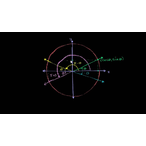
Sal finds several trigonometric identities for sine and cosine by considering horizontal and vertical symmetries of the unit circle. Class …
VideoFree8
check_box_outline_blank
Organic chemistry: Three-dimensional bond-line structures

How to represent three-dimensional molecules using bond-line structures Organic chemistry Sal and Jay cover topics covered in college organ…
VideoFree11 minutes
check_box_outline_blank
Class 11 Physics (India): Work done by isothermic process
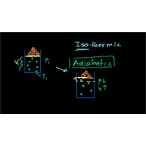
Isothermic and adiabatic processes. Calculating the work done by an isothermic process and seeing that it is the same as the heat added. Cl…
VideoFree19 minutes
check_box_outline_blank
Class 11 Physics (India): Relative velocity in 2D
How fast is the sheep moving as seen by the lion? In previous videos, we have already seen how to calculate relative velocity in 1D. In thi…
VideoFree9
check_box_outline_blank
Class 11 Physics (India): Newton's Law of Cooling
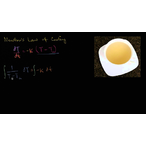
Newton's law of cooling can be modeled with the general equation dT/dt=-k(T-Tₐ), whose solutions are T=Ce⁻ᵏᵗ+Tₐ (for cooling) and T=Tₐ-Ce⁻ᵏ…
VideoFree10