Class 11 Physics (India): Graph of y=sin(x)


Description
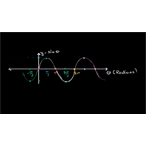
The graph of y=sin(x) is like a wave that forever oscillates between -1 and 1, in a shape that repeats itself every 2π units. Specifically, this means that the domain of sin(x) is all real numbers, and the range is [-1,1]. See how we find the graph of y=sin(x) using the unit-circle definition of sin(x).
Class 11 Physics (India)
Let's learn, practice, and master topics of class 11 physics (NCERT) starting with kinematics and then moving to dynamics with Newton's laws of motion, work, energy, and power. Let's then use these as the foundation to learn about centre of mass, rotational motion, gravitation, solids, fluids, thermodynamics, and oscillations and waves.
The graphs of sine, cosine, an…
Frequently asked questions
There are no frequently asked questions yet. If you have any more questions or need help, contact our customer service.
The graph of y=sin(x) is like a wave that forever oscillates between -1 and 1, in a shape that repeats itself every 2π units. Specifically, this means that the domain of sin(x) is all real numbers, and the range is [-1,1]. See how we find the graph of y=sin(x) using the unit-circle definition of sin(x).
Class 11 Physics (India)
Let's learn, practice, and master topics of class 11 physics (NCERT) starting with kinematics and then moving to dynamics with Newton's laws of motion, work, energy, and power. Let's then use these as the foundation to learn about centre of mass, rotational motion, gravitation, solids, fluids, thermodynamics, and oscillations and waves.
The graphs of sine, cosine, and tangent
Learn how the graphs of y=sin(θ), y=cos(θ), and y=tan(θ) look, using the unit circle definition of the functions.
Topic: Science
Learn about all the sciences, from physics, chemistry and biology, to cosmology and astronomy, across hundreds of videos, articles and practice questions.
Share your review
Do you have experience with this video? Submit your review and help other people make the right choice. As a thank you for your effort we will donate $1.- to Stichting Edukans.There are no frequently asked questions yet. If you have any more questions or need help, contact our customer service.